🇬🇷 Country guide · updated 2026-09
Drone laws in Greece
Greece is the country where the aviation rules are the easier half of the problem.
At a glance
- Registration
- €20
- Registration portal
- HCAA UAS portal
- Maximum height
- 120 m above ground level in the Open category.
- Insurance
- Required for professional use, and from 4 kg privately
- Authority
- HCAA (Hellenic Civil Aviation Authority)
Greece is the country where the aviation rules are the easier half of the problem. The archaeological sites that draw most drone pilots here are governed by the antiquities code, and flying over one needs a permit from the local ephorate of antiquities as well as permission from the aviation authority — two bodies, two applications, and no single desk. The aviation side has its own quirk: a national regulation from 2016 that still stands alongside the EU rules and contains the 8 km airport figure people quote, while the authority's own current guidance sends you to the DAGR platform instead. Everything official also moved address recently, so older guides link to infrastructure that no longer answers.
Country-specific decision path
Before you choose a launch point in Greece
- Confirm your operator paperwork Registration required — €20. In the EU. One EU/EEA operator registration covers this country. Open HCAA UAS portal
- Check the exact route on the official map Drone Aware GR is the national starting point; read every condition covering the complete route, not only the launch pin. Open Drone Aware GR
- Apply the local layer An EU or EEA registration is valid in Greece. Review the Greece zone and nature checks
Registration in Greece
Greece applies Regulations 2019/947 and 2019/945, but it also still publishes a national UAS regulation from 2016 that predates them, and the authorities have not repealed it — we could find no repealing instrument. That leaves two layers with different logic, which is why the 8 km airport rule and the DAGR-based approach coexist awkwardly. The regulator has also been renamed and its web estate moved: the portal is branded ΑΠΑ, a 2025 law re-established ΥΠΑ as a public-law entity, and DAGR has moved to the air navigation service provider. Any guide written before 2025 is pointing at dead addresses.
The fee is €20, paid through the Greek e-paravolo system under code 8356 — the same code as the remote pilot certificate, which also costs €20. The portal moved: it is now uas.hcaa.gov.gr, and the old uas.hcaa.gr address belongs to legacy infrastructure. Registration can be renewed after three years. Note the two validities are different — the operator registration runs three years, the pilot competency certificate five.
What it costs: €20 — Three years.
In the EU. One EU/EEA operator registration covers this country.
How to register
- Register as an operator in your own country if you live in the EU or EEA
- If Greece is the first EASA state you will fly in: register at uas.hcaa.gov.gr and pay the €20 e-paravolo, code 8356
- Display the GRC operator number on every drone, and load the three secret characters into Remote ID
- Arrange third-party liability insurance — Greek law requires it well below the EU threshold
- Check DAGR before every flight; HCAA describes this as mandatory
- For a restricted zone, file the request at least five working days ahead — and longer if the defence staff must approve it
You register as an operator — not the drone. Registration is required from 250 g, or below 250 g if the drone can transfer more than 80 J of energy, or if it carries a sensor able to capture personal data. CE-marked toys are exempt. Put your operator number on every drone you fly and set it in Remote ID.
Flight rules
- Maximum height
- 120 m above ground level in the Open category.
- Line of sight
- Visual line of sight required for Open category. Greek islands' terrain requires extra attention to line of sight maintenance.
- Weight classes
- Standard EU weight categories apply. All camera-equipped drones need registration.
- Night flying
- Night flying is allowed in the Open category. A drone with a class mark must show a flashing green light so it stays visible. You still have to keep it in sight, which is harder after dark, and national geographical zones apply exactly as they do in daylight.
- Weather
- Good weather required. Aegean wind (Meltemi) can be extremely strong in summer - careful assessment essential.
Class marks C0–C6 have been mandatory since 1 January 2024. The transition period is over: a drone without a class mark may only be flown in A1 (under 250 g) or A3 (under 25 kg).
Where you may not fly
There is no single EU-wide distance from airports. Each country publishes its own UAS geographical zones, so check the national map or app before every flight.
Airports and controlled airspace
The 8 km figure is real, unlike the Spanish one. It comes from the Greek national UAS regulation of 2016, still published by the authorities in both languages: article 5 prohibits flight within aerodrome traffic zones and in any case closer than 8 km from the airport perimeter, and article 19 requires special HCAA permission closer than 8 km to a controlled aerodrome, airfield or heliport. The complication is that the regulation predates EU Regulation 2019/947, and HCAA's own current guidance page does not repeat the 8 km figure at all — it tells operators to check DAGR instead. Treat 8 km as the published national rule and DAGR as what actually decides your flight.
Towns and cities
Urban flying restricted. Athens historic center has extensive restrictions beyond archaeological site zones.
Protected nature
Environmental protection areas are on the 2016 regulation's list of places needing special HCAA permission, alongside archaeological sites. Marine protected areas and seasonal nesting restrictions apply through environmental law rather than aviation law, and they are enforced by different bodies.
Government and military sites
Military zones are extensive due to regional security considerations. Border areas have additional restrictions. Military bases on islands create large no-fly zones.
Other restrictions in Greece
- Archaeological sites need permission from the Ministry of Culture as well as from HCAA — two separate permits from two separate bodies
- Aerial firefighting: HCAA issued a safety bulletin in July 2025 setting out that drone interference can bring criminal prosecution for obstructing a public service, plus seizure of the aircraft
- Requests involving defence-controlled airspace go through the national defence staff, which requires at least five working days
Insurance
Greece requires third-party liability cover for any drone used professionally, at any weight, and for private-use drones from 4 kg. The 2016 national UAS regulation sets the sums at €150,000 for damage to third-party property and €1,000,000 for bodily injury. The HCAA portal states the 4 kg private threshold without naming the instrument it comes from, and it does not match the 2016 regulation's own wording, which is framed by category and commercial use rather than by weight — so the two official statements are not fully reconcilable. Carry cover either way.
Penalties
We previously published a figure of «up to roughly €250,000» for flying over an archaeological site, attributed to Law 4858/2021. We have withdrawn it. On re-checking we could not find that figure anywhere in Law 4858/2021, in the earlier Law 3028/2002, or in any Greek-language source, and we traced it to a drone blog that cites nothing. What is verified is the structure rather than the amount: the antiquities code requires a permit from the competent ephorate for filming a monument or site, the 2016 UAS regulation requires separate HCAA permission for flying above or close to an archaeological site, and enforcement in the one well-documented case — the Acropolis drone display in May 2025 — took the form of a criminal complaint by the Ministry of Culture, with no fine amount announced. The aviation penalties route to article 153 of the Code of Air Law, whose amounts we have not been able to read from an official source. Greece publishes no drone-specific fine schedule that we can cite.
Whatever the amount, the pattern across Europe is the same: paperwork failures are handled administratively, while flying near aircraft, over crowds, or inside a protected zone is what turns a case into a prosecution.
Visiting Greece with a drone
An EU or EEA registration is valid in Greece. A non-EU visitor registering here pays €20 through the e-paravolo system. The two things that catch visitors are both about permission rather than paperwork: DAGR must be checked before every flight and used to request anything in a restricted zone, and archaeological sites — which is a great deal of what people come to photograph — require a permit from the local ephorate of antiquities under the antiquities code, quite separately from the aviation permission. Greek insurance rules also bite lower than the EU's.
Commercial work
Insurance is the first difference: it is required for any professional use at any weight, where private flying only triggers it from 4 kg. Beyond that, a flight operation licence costs €200 under e-paravolo code 8358, and training-centre approvals carry their own fees. Filming at an archaeological site is charged by the Ministry of Culture under its reproduction-fee instruments, and the amounts are substantial and set case by case — published decisions from 2025 show fees running from a four-figure sum for a feature film to a charge levied per second of footage for a documentary. News reporting has been granted fee-exempt.
Location planning
These are well-known photographic subjects to research, not recommended launch points or proof that a flight is allowed. Check the exact route against official airspace, nature, land-manager and people restrictions.
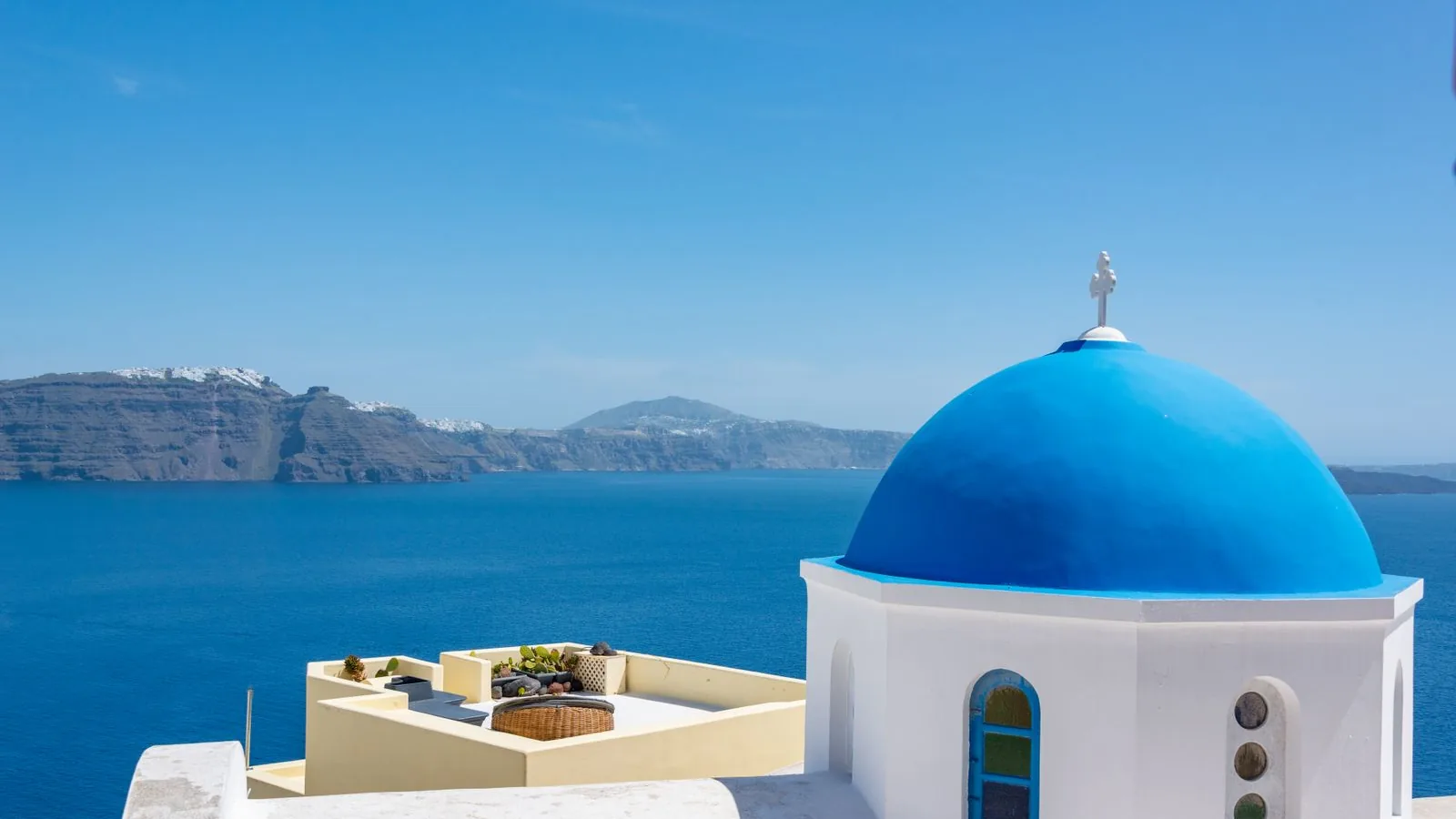
- Santorini caldera views (avoid over towns and cruise ports)
- Meteora monasteries area (strict restrictions near monasteries)
- Zakynthos Navagio Beach (shipwreck) - popular but check restrictions
- Crete mountain landscapes
- Peloponnese coastal areas
- Northern Greece mountain regions
Apps and official maps
- DAGR (Drone Aware GR) at dagr.hasp.gov.gr — the airspace-awareness and flight-request system. HCAA calls checking it mandatory before any flight. Note it moved off the HCAA domain to the air navigation provider's
- uas.hcaa.gov.gr — registration and pilot certificates. The old uas.hcaa.gr address is legacy
Practical tips
- Check DAGR before flying — HCAA words this as an obligation, not a suggestion
- Submitting a flight request in DAGR is not the same as having it approved. The system says so itself
- Three different lead times apply: 60 minutes for a general request, five working days for a restricted zone, five working days for anything the defence staff must clear
- Archaeological sites need a Ministry of Culture permit from the local ephorate, separate from any HCAA permission
- Insurance is required here for professional use at any weight, and privately from 4 kg
- Every official Greek drone URL changed. hcaa.gr, uas.hcaa.gr and the old DAGR address are all legacy
- In summer, aerial firefighting zones appear at short notice and interfering with them is treated as a criminal matter, not an administrative one
Questions about flying in Greece
Do I need to register to fly a drone in Greece?
Registration required — €20. In the EU. One EU/EEA operator registration covers this country.
How high can I fly in Greece?
120 m above ground level in the Open category.
Do I need drone insurance in Greece?
Greece requires third-party liability cover for any drone used professionally, at any weight, and for private-use drones from 4 kg. The 2016 national UAS regulation sets the sums at €150,000 for damage to third-party property and €1,000,000 for bodily injury. The HCAA portal states the 4 kg private threshold without naming the instrument it comes from, and it does not match the 2016 regulation's own wording, which is framed by category and commercial use rather than by weight — so the two official statements are not fully reconcilable. Carry cover either way.
Can I fly a drone at night in Greece?
Night flying is allowed in the Open category. A drone with a class mark must show a flashing green light so it stays visible. You still have to keep it in sight, which is harder after dark, and national geographical zones apply exactly as they do in daylight.
What are the penalties for breaking drone rules in Greece?
We previously published a figure of «up to roughly €250,000» for flying over an archaeological site, attributed to Law 4858/2021. We have withdrawn it. On re-checking we could not find that figure anywhere in Law 4858/2021, in the earlier Law 3028/2002, or in any Greek-language source, and we traced it to a drone blog that cites nothing. What is verified is the structure rather than the amount: the antiquities code requires a permit from the competent ephorate for filming a monument or site, the 2016 UAS regulation requires separate HCAA permission for flying above or close to an archaeological site, and enforcement in the one well-documented case — the Acropolis drone display in May 2025 — took the form of a criminal complaint by the Ministry of Culture, with no fine amount announced. The aviation penalties route to article 153 of the Code of Air Law, whose amounts we have not been able to read from an official source. Greece publishes no drone-specific fine schedule that we can cite.
Official sources
Primary sources used for this guide, checked September 2026. Open the live national source again before flying; geographical zones and temporary restrictions can change between reviews.
- National authority HCAA (Hellenic Civil Aviation Authority) — official drone information
- Registration HCAA UAS portal
- Official zones and map Drone Aware GR — HASP / HCAA
- European framework Regulation (EU) 2019/947 — rules and procedures for operating unmanned aircraft
- Official maps directory EASA — national aviation authorities and geographical-zone sources
Rules change, and national authorities publish the current position. Before you fly, check HCAA (Hellenic Civil Aviation Authority) — it is linked at the top of this page too.