🇮🇪 Country guide · updated 2026-09
Drone laws in Ireland
Ireland is more permissive than its reputation on the flying rules and stricter than most people expect on the ground.
At a glance
- Registration
- €41
- Registration portal
- IAA MySRS
- Maximum height
- 120 m above ground level in the Open category.
- Insurance
- Not required by national law
- Authority
- IAA (Irish Aviation Authority)
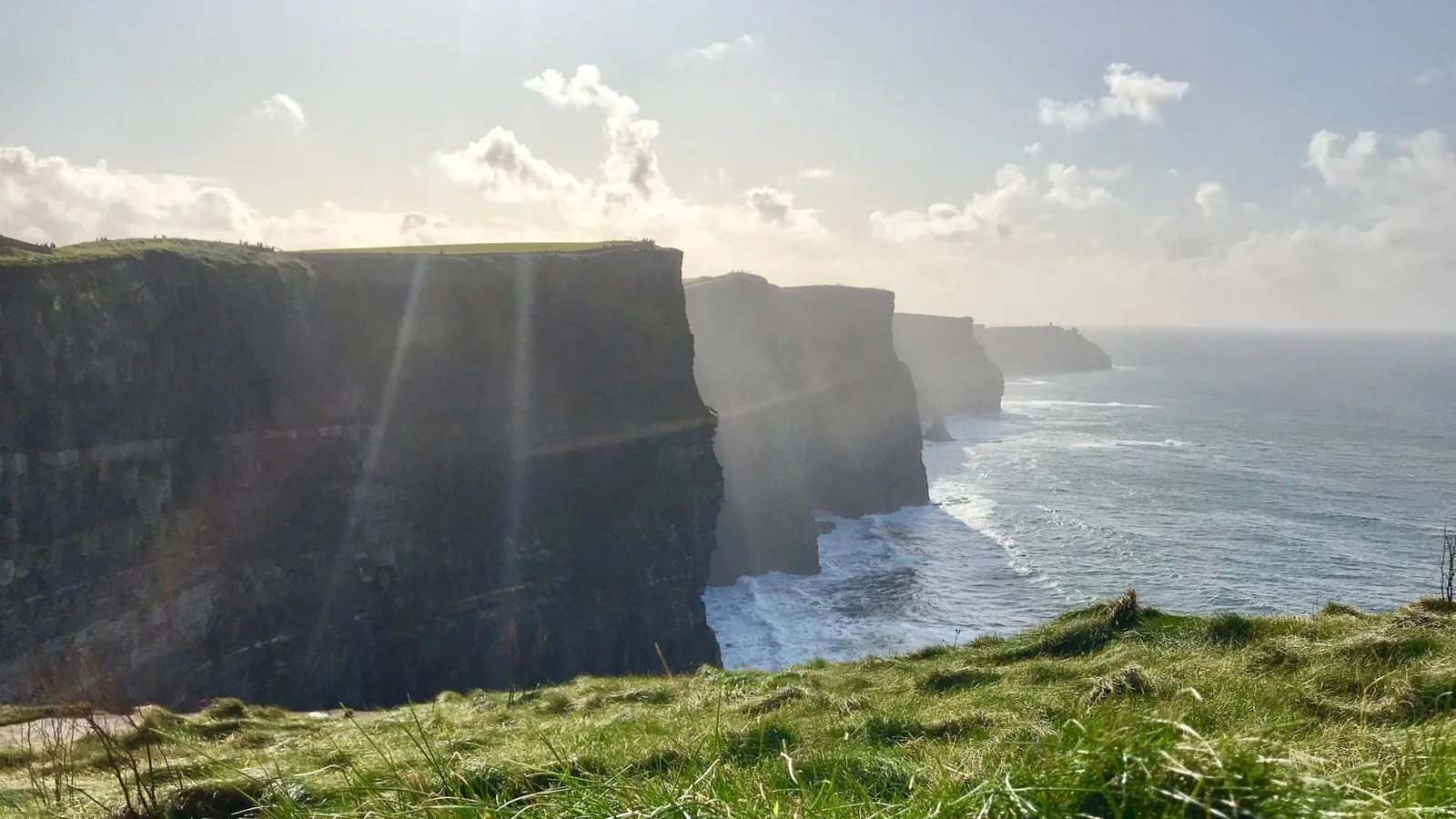
Ireland is more permissive than its reputation on the flying rules and stricter than most people expect on the ground. The 2023 statutory instrument that implements the EU framework revoked the old Irish order and did not replace its distance rules — so there is no longer a national 30-metre rule, no 300-metre crowd rule and no 5-kilometre aerodrome rule, only the European ones. What constrains you instead is who owns the place you want to film. Every site run by the Office of Public Works prohibits drones outright, and that covers Newgrange, Skellig Michael and Phoenix Park. The national parks require a permit and grant few. And the Cliffs of Moher are a protected bird area where drones are prohibited from April to September.
Country-specific decision path
Before you choose a launch point in Ireland
- Confirm your operator paperwork Registration required — €41. In the EU. One EU/EEA operator registration covers this country. Open IAA MySRS
- Check the exact route on the official map IAA UAS geographical zones is the national starting point; read every condition covering the complete route, not only the launch pin. Open IAA UAS geographical zones
- Apply the local layer An EU or EEA registration is valid in Ireland and does not need repeating — the IAA says so directly. Review the Ireland zone and nature checks
Registration in Ireland
Ireland applies Regulations 2019/947 and 2019/945 through a 2023 statutory instrument that did something worth knowing about: it revoked the 2015 drone order outright, and it replaced its distance rules with nothing. The current instrument contains no distance or height figures at all — the only national additions are data protection duties, requiring processing to comply with data protection law and an impact assessment where one is needed, plus a reserved power for the IAA to set minimum heights for privacy reasons, which we found no sign of having been used. So in Ireland the distances from people and structures are simply the EU open-category rules. Geographical zones are published in the EU common digital format and directed by aeronautical notice, currently at its August 2026 issue.
The €41 fee and the two-year validity are both correct — we checked them against the IAA's own fee schedule, current version effective 1 January 2026. Note that the fee is not printed on the registration page itself, only in the schedule. Minimum age is 16; a parent or guardian can register on behalf of someone younger. Registration is of the operator, not the aircraft, and the camera limb catches more people than the weight one: a sub-250 g drone with a camera still requires it.
What it costs: €41 — Valid 2 years.
In the EU. One EU/EEA operator registration covers this country.
How to register
- Visit the IAA MySRS portal at mysrs.iaa.ie
- Create an account with personal details
- Complete operator registration
- Register each drone
- Receive your EU operator ID
- Complete required online training
- Review IAA drone safety map for restrictions
You register as an operator — not the drone. Registration is required from 250 g, or below 250 g if the drone can transfer more than 80 J of energy, or if it carries a sensor able to capture personal data. CE-marked toys are exempt. Put your operator number on every drone you fly and set it in Remote ID.
Flight rules
- Maximum height
- 120 m above ground level in the Open category.
- Line of sight
- Visual line of sight required. Irish weather and coastal conditions affect visibility.
- Weight classes
- Standard EU weight classifications.
- Night flying
- Night flying is allowed in the Open category. A drone with a class mark must show a flashing green light so it stays visible. You still have to keep it in sight, which is harder after dark, and national geographical zones apply exactly as they do in daylight.
- Weather
- Good weather required. Ireland's Atlantic climate means frequent rain, strong winds, and rapidly changing conditions. Always check Met Éireann forecasts.
Class marks C0–C6 have been mandatory since 1 January 2024. The transition period is over: a drone without a class mark may only be flown in A1 (under 250 g) or A3 (under 25 kg).
Where you may not fly
There is no single EU-wide distance from airports. Each country publishes its own UAS geographical zones, so check the national map or app before every flight.
Airports and controlled airspace
Ireland publishes no national airport radius, and we are deliberately not printing one. Protection is zone by zone in the IAA's geo-zone direction, keyed to each aerodrome's control zone and tiered red, amber and green — so the answer genuinely differs between Dublin, Cork and Shannon, and it changes. Cork moved twice in 2026 alone: a coordination requirement was introduced in February and then largely withdrawn in May after consultation, leaving visual flight under the standard rules while beyond-visual-line-of-sight work still needs IAA approval. Read the zone map and the current notice rather than any figure written on a page, ours included.
Towns and cities
Dublin sits inside the Dublin Control Zone, published as geo-zone U27, with a red zone at its core. Enforcement there is technological and real: unauthorised survey flights in Finglas, under two kilometres from the airport perimeter, were picked up by the airport's drone detection system and pursued by the regulator against the company responsible in 2025. Note also that temporary national-security zones over Dublin are now part of the toolkit — one was imposed for three days in late 2025 covering the whole control zone, with access controlled by An Garda Síochána and operating inside it made a criminal offence.
Protected nature
National parks require a permit and grant them sparingly. Connemara's wording is that drones are allowed only under permit and only in very special circumstances, with evidence of insurance and licences required; the Burren states that national parks do not allow drones on their properties unless specific permission has been granted. Permits come from the individual park office rather than from a central NPWS scheme — drones do not appear on the NPWS list of centrally issued permits at all. Coverage is uneven, so treat «permission required» as the rule and ask the park rather than assuming a published policy exists for the one you are visiting.
Government and military sites
Sensitive infrastructure is covered by prohibited zones in the IAA's geo-zone direction. We are not listing individual sites: the current issue of that notice was not readable from an official URL when we checked, and the figures in the superseded issue we could read are two years and six revisions old.
Other restrictions in Ireland
- Every site run by the Office of Public Works prohibits drones outright — see below
- The Cliffs of Moher are a Special Protection Area, and drone use is prohibited there during the bird nesting season, April to September
- Control zone coordination goes to AirNav Ireland, not to the IAA — the two were separated in 2023
- Data protection law applies to the footage: recreational flying may fall under the household exemption, but not once the camera captures surrounding private property or public space
Insurance
There is no Irish requirement below the EU threshold. The statutory instrument gives the IAA a conditional power — operators shall be insured where directed by the authority — rather than imposing a blanket duty, and it names no weight and no minimum sum. One caveat worth carrying: the IAA's own FAQ words it as insurance being required «unless for recreational purposes and under 20 kg», which reads as expecting commercial operators to be covered at any weight. The binding instruments do not say that, and we are not going to resolve the tension in either direction. Commercial work is normally insured regardless.
Penalties
The penalties are not in the drone instrument — that contains no penalties article at all — but in the parent aviation act, which is why they are framed as court maxima rather than as a tariff. Liability extends to company directors and managers. Note also what does not yet exist: the national policy framework published in August 2025 committed the government to introducing fixed-charge offences for drone violations, but we found no implementing instrument, so there are no on-the-spot fines in Ireland today.
| Breach | Penalty | Source |
|---|---|---|
| Summary conviction | Up to €5,000 and/or 6 months' imprisonment | Irish Aviation Authority Act 1993 s.74, as amended by the Aviation Act 2006. The court may also order forfeiture of the equipment. |
| Conviction on indictment | Up to €500,000 and/or 3 years' imprisonment | Same section. A ceiling for the most serious cases, not a typical outcome. |
| What an actual prosecution produced | €5,000 in costs | IAA prosecution reported February 2024: a guilty plea to several offences after flying a drone over 6 kg above a Galway shopping centre. The published figure is costs ordered, not a fine imposed. |
Whatever the amount, the pattern across Europe is the same: paperwork failures are handled administratively, while flying near aircraft, over crowds, or inside a protected zone is what turns a case into a prosecution.
Visiting Ireland with a drone
An EU or EEA registration is valid in Ireland and does not need repeating — the IAA says so directly. Open-category visitors need nothing further; Specific-category operators need cross-border paperwork, and a foreign operator confirmation is charged at €565. The two things that will actually shape your trip are heritage and nature. Every site run by the Office of Public Works prohibits drones outright, and that is a long list of exactly what people come to photograph — Newgrange, Skellig Michael, Phoenix Park. The national parks require a permit from the park itself and grant them sparingly. And the Cliffs of Moher are closed to drones through the nesting season from April to September, which is most of the tourist year.
Commercial work
Specific-category operators registered elsewhere need a cross-border authorisation to work in Ireland, and the IAA charges €565 for a foreign operator confirmation. Beyond that the EU risk categories decide. Two Irish specifics matter to professional work: filming at an OPW site is licensed through the site's own process and the drone prohibition is not waived by it, and Phoenix Park filming requires a licence from the Park Superintendent with at least three business days' notice and public liability insurance of €6.5 million. Beyond-visual-line-of-sight work in the Cork zone still requires explicit IAA approval even after the May 2026 relaxation.
Location planning
These are well-known photographic subjects to research, not recommended launch points or proof that a flight is allowed. Check the exact route against official airspace, nature, land-manager and people restrictions.
- Wild Atlantic Way coastal cliffs (weather permitting)
- Connemara countryside and lakes
- Ring of Kerry landscapes
- Skellig Islands area (restrictions around the islands themselves)
- Dingle Peninsula
- Wicklow Mountains south of Dublin
Apps and official maps
- iaa.mysrs.ie — the Irish Aviation Authority's registration and certification portal
- IAA UAS Geographic Zones map — the authority's own ArcGIS viewer, with a downloadable GeoJSON. The IAA labels it reference only, not for navigation
Practical tips
- Every OPW heritage site prohibits drones — no application, no conditional approval. That covers Newgrange, Skellig Michael, Phoenix Park and the rest
- The Cliffs of Moher restriction is ecological, not a visitor-centre boundary. It is a Special Protection Area and drones are prohibited during nesting season, April to September, along the cliffs
- National parks need a permit from the individual park, and Connemara says it grants them only in very special circumstances
- Airspace coordination goes to AirNav Ireland. The IAA regulates; AirNav runs the air traffic side, and they have been separate bodies since 2023
- Ireland's old national rules — 30 m from people, 300 m from crowds, 5 km from aerodromes — were revoked in February 2023. Guides still quoting them are describing repealed law
- The zone map carries the IAA's own warning in capitals: reference only, not to be used for navigation. Check notices and NOTAMs as well
- Fixed-charge on-the-spot fines for drone offences are announced government policy, not law. Nothing has been enacted
Questions about flying in Ireland
Do I need to register to fly a drone in Ireland?
Registration required — €41. In the EU. One EU/EEA operator registration covers this country.
How high can I fly in Ireland?
120 m above ground level in the Open category.
Do I need drone insurance in Ireland?
There is no Irish requirement below the EU threshold. The statutory instrument gives the IAA a conditional power — operators shall be insured where directed by the authority — rather than imposing a blanket duty, and it names no weight and no minimum sum. One caveat worth carrying: the IAA's own FAQ words it as insurance being required «unless for recreational purposes and under 20 kg», which reads as expecting commercial operators to be covered at any weight. The binding instruments do not say that, and we are not going to resolve the tension in either direction. Commercial work is normally insured regardless.
Can I fly a drone at night in Ireland?
Night flying is allowed in the Open category. A drone with a class mark must show a flashing green light so it stays visible. You still have to keep it in sight, which is harder after dark, and national geographical zones apply exactly as they do in daylight.
What are the penalties for breaking drone rules in Ireland?
The penalties are not in the drone instrument — that contains no penalties article at all — but in the parent aviation act, which is why they are framed as court maxima rather than as a tariff. Liability extends to company directors and managers. Note also what does not yet exist: the national policy framework published in August 2025 committed the government to introducing fixed-charge offences for drone violations, but we found no implementing instrument, so there are no on-the-spot fines in Ireland today.
Official sources
Primary sources used for this guide, checked September 2026. Open the live national source again before flying; geographical zones and temporary restrictions can change between reviews.
- National authority IAA (Irish Aviation Authority) — official drone information
- Registration IAA MySRS
- Official zones and map IAA UAS geographical zones — Irish Aviation Authority
- European framework Regulation (EU) 2019/947 — rules and procedures for operating unmanned aircraft
- Official maps directory EASA — national aviation authorities and geographical-zone sources
Rules change, and national authorities publish the current position. Before you fly, check IAA (Irish Aviation Authority) — it is linked at the top of this page too.